how missions work
research, draft, publish, engage — on repeat.
a mission is the core unit of work. the agent follows a strategy you approve, generates content grounded in your knowledge base, and publishes across platforms. every action is logged. every decision is auditable.
agent-driven campaigns
a mission is a promotion campaign for a subject. the agent researches, drafts, publishes, and engages — autonomously or with human approval at every step.
adjustable autonomy
set the autonomy level per mission. supervised agents file decisions for human approval. autonomous agents execute directly. change the dial at any time.
strategy proposals
before going live, the agent proposes a strategy — posting cadence, platform mix, content pillars. review and approve it, or let the agent iterate.
multi-subject support
promote people, products, or brands. each subject carries a voice model and publishing recipe. run multiple missions for the same subject across different goals.
budget & spend tracking
set budgets per mission. track AI usage costs, ad spend, and ROI in real time. the agent respects spending limits automatically.
pause, resume, restore
pause a mission when you need to. resume it and the agent picks up where it left off. deleted missions are soft-deleted — restore them from the trash.
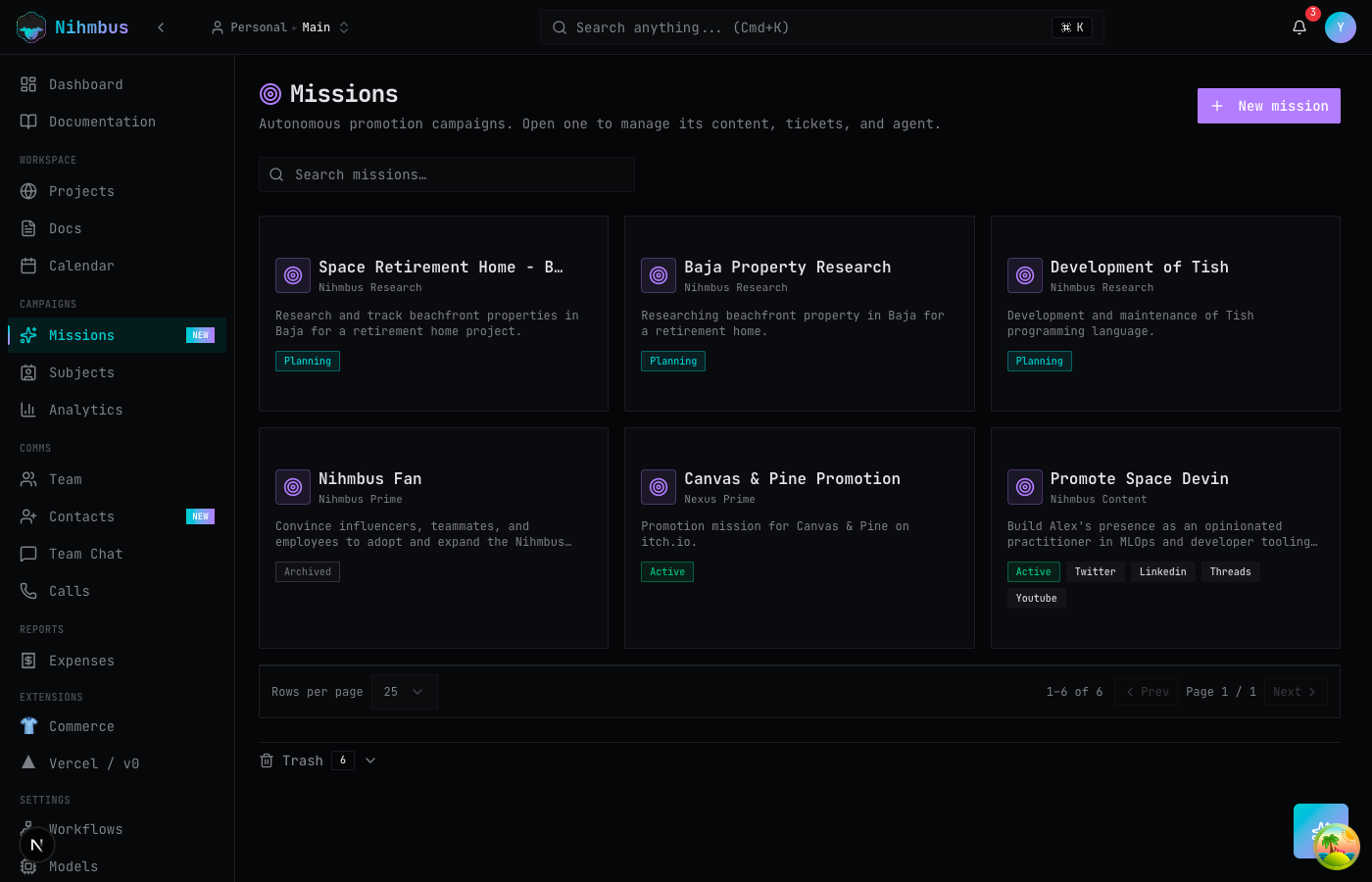
the missions dashboard
see every campaign at a glance.
each mission card shows the subject, autonomy level, connected platforms, and real-time engagement metrics. filter by status, sort by performance, and drill into any mission for the full strategy, drafts, and analytics.
subjects & voice
every subject has a voice.
subjects are what you promote — people, products, brands. each one carries a trained voice model so the agent writes consistently, no matter which mission is running.
subject voice models
each subject carries a voice model trained on existing content. the agent writes in that voice consistently across every channel and every mission.
publishing recipes
define per-subject recipes that control tone, format, hashtag style, and platform-specific rules. the agent resolves the recipe before generating content.
mission personas
attach posting identities to a mission — the social accounts and personas the agent publishes as. switch personas mid-campaign without losing history.
faq
questions about missions
what is a mission?
a mission is an agent-driven promotion campaign for a subject (a person, product, or brand). it carries a strategy, an autonomy level, and a budget. the agent ticks through the mission to research, draft, publish, and engage.
what is a subject?
a subject is whatever a mission promotes — a person, a product, or a brand. subjects carry a voice model and a publishing recipe that the agent uses to generate consistent, on-brand content.
can I run multiple missions for the same subject?
yes. you might run a product launch mission and a thought leadership mission for the same brand simultaneously. each mission has its own strategy, autonomy level, and budget.
how does the autonomy dial work?
supervised agents propose every mutating action (publish, send DM, spend money) as a decision for human approval. semi-autonomous agents auto-execute reads and queue writes. fully autonomous agents run end-to-end.
under the hood
headless publishing, explainable scoring.
the agent doesn't just call APIs. it drives real browser sessions for platforms without public endpoints, scores every draft with five real signals, and deduplicates content using vector similarity — all before anything reaches your feed.
headless browser publishing
platforms without public APIs (LinkedIn DMs, Reddit, Hacker News, itch.io, Patreon) are reached via persistent browser sessions. the agent logs in once and reuses the session — no developer app required.
API + browser, unified
OAuth-based platforms use their APIs. browser-only platforms use headless sessions. the agent picks the right path automatically — same publishing pipeline, same content review flow.
5-signal content scoring
every draft gets an explainable 0–1 score: pillar fit (strategy alignment), novelty (pgvector cosine distance from existing drafts), voice fit, constraint fit (platform char limits), and historical engagement of the nearest past post.
semantic deduplication
before generating content, the agent embeds the idea and checks cosine distance against every existing draft in the mission. near-duplicates are rejected before they waste a generation cycle.